Digital Twin-Empowered Smart Systems
Based on the smart mobility research field, the Sakaguchi-Tran Laboratory explores digital twin-empowered smart systems for next-generation wireless networks. By integrating real-time sensing, communication, and cyber-physical modeling, our research aims to enhance system intelligence, adaptability, and reliability in complex urban environments.
Digital Twin-Based Autonomous Car-Sharing Services
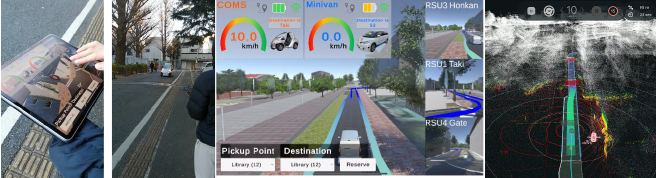
We developed digital twin-based autonomous car-sharing services that integrate real-time sensory data from road-side units and autonomous vehicles to address urban traffic congestion. The proposed system leverages the age-of-information (AoI) metric to optimize vehicle routing by maintaining data freshness and dynamically adapting to real-time traffic conditions.
Both simulation and experimental results demonstrate improvements in overall traffic efficiency and consistent information freshness across the mobility digital twin.
Fig.7 Digital twin-based autonomous car-sharing service applications.
Digital Twin-Enabled Multi-Hop mmWave V2X Communications
We propose a digital twin-enabled multi-hop mmWave V2X communication architecture for complex urban environments. By integrating an intelligent V2X control plane with a digital twin-based routing algorithm, the system optimizes communication paths using real-time data and blockage prediction.
The digital twin fuses physical and cyber-world data, including 3D maps, building models, and real-time sensing, to simulate future communication states and dynamically adjust routes. This approach improves connectivity reliability and communication efficiency under frequent blockages.
Fig.8 Overview of digital twin-enabled multi-hop mmWave V2X communication.
Digital Twin-Empowered Signage Advertising Platform
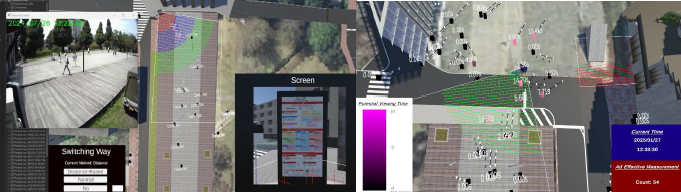
We propose a digital twin-empowered signage advertising platform and deploy a prototype system on the Ookayama campus. The system collects real-world data through sensors and constructs a 3D digital twin that reflects the physical environment.
By leveraging the digital twin, the platform enables adaptive content delivery based on surrounding conditions and provides new capabilities for tracking pedestrian behavior after advertisement exposure.
Fig.9 Digital twin-empowered signage advertising platform.

 SAKAGUCHI & TRAN LAB